
Trellising Twine for Tomato and Pepper: Reading #3200, #2500 and #2100 Against Crop Load and Season Length
Author: Oğuz Kaan Çiçek — ANSA Sustainability Unit
The problem: the twine carries the whole crop, for the whole season
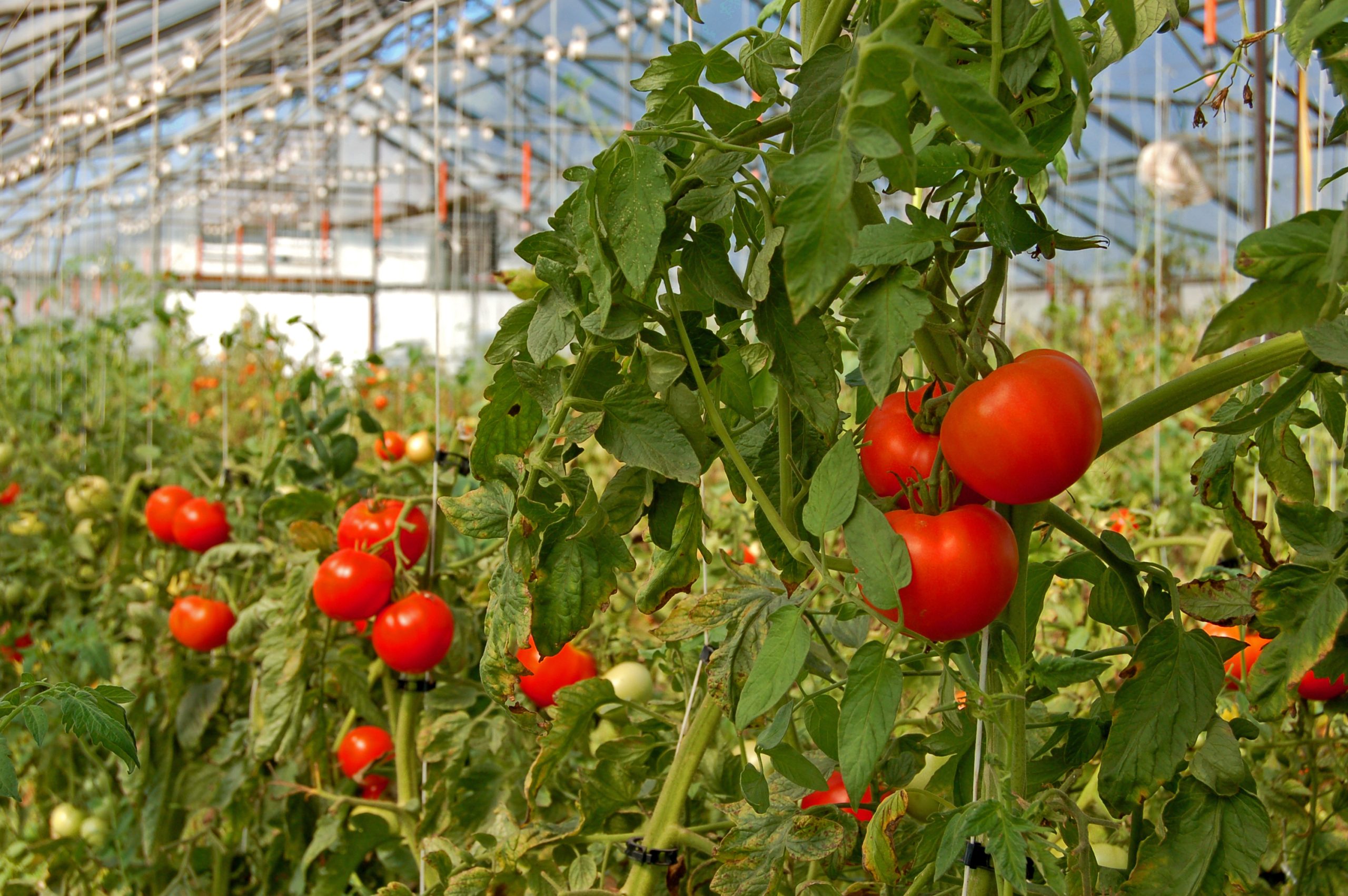
Trellising a tomato or pepper plant is a yield decision before it is a logistics decision. The plant is held upright against its own stem weight and against every cluster of fruit it sets; the canopy stays open to spray penetration and air, fungal pressure drops, and picking becomes a standing-height, worker-friendly operation. ANSA designed its Trellising Twine specifically for tomato and pepper growers, and the agronomic case is exactly this: trellised crops deliver higher quality, superior yields and safer fruit, with more effective spraying and more efficient harvesting.
The failure mode is equally specific. A support twine that snaps mid-season does not just drop one plant — the adjacent plants on the same span lose their anchor and the row collapses with it, in the worst possible week: full fruit load, full canopy, no recovery time before harvest.
So the buying question is not “which twine is strongest” but “which runnage–strength point fits my crop system, my span width and my season length.” This article reads ANSA’s three Trellising Twine types — #3200, #2500 and #2100 — against those variables.
What the twine is actually holding
Three load regimes act on a trellising twine, and they differ from baler twine in one decisive way: exposure time.
- Static crop load. Stem, foliage and accumulated fruit weight, carried continuously from transplanting to clearance. In a vertical string system the load concentrates where the twine meets the hook or clip; in a stake-and-weave (Florida weave / basketweave) system the load distributes across the weave between two stakes, and the twine tension at each wrap point carries the row laterally.
- Dynamic spikes. Every training pass, every lowering step in a lower-and-lean high-wire system, every gust in an open-field planting adds short, sharp loads on top of the static weight.
- Season-long UV exposure. Unlike a bale twine that works for weeks, a trellising twine hangs in full sun — or under glazing that filters some but not all radiation — for the entire growing season. Unstabilised polypropylene loses tensile strength badly under UV exposure; published work on unstabilised PP reports severe strength loss within days of intense UV exposure, and roughly 59% tensile-strength decline after 625 days of outdoor exposure. Stabilisation is therefore not an option in this product class; it is the difference between a twine that holds its specified breaking load in week 30 and one that does not.
The decision variables that follow: crop system (which sets the load geometry), span and fruit load (which set the strength demand), and season length (which sets the UV demand and the metres you will consume).
The type table, read as a decision tool
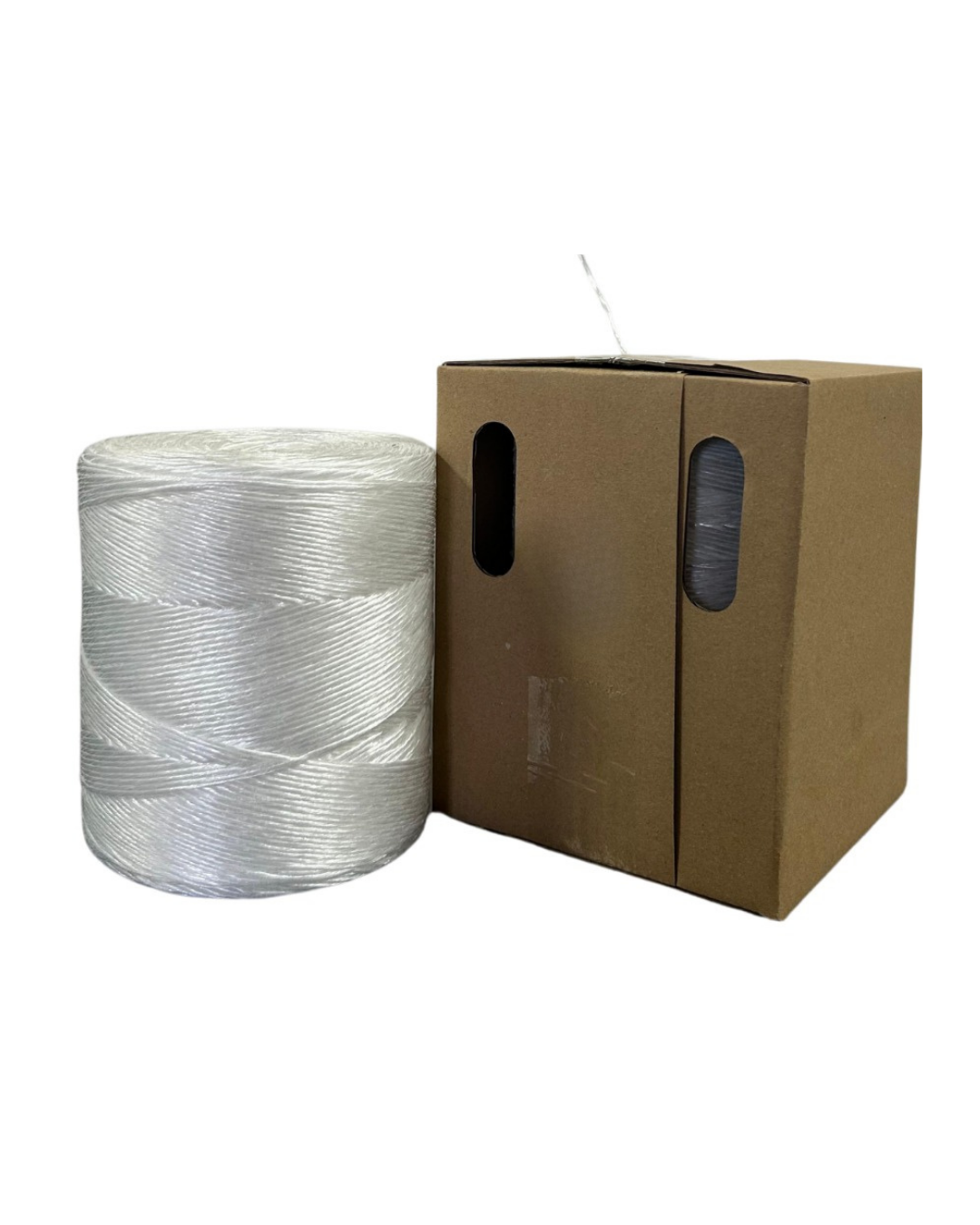
| Type | m/kg | Breaking Load (kg) | Spool Weight (kg) | Length/Spool (m) | Spool/Pallet | Kg/Pallet | Color |
|---|---|---|---|---|---|---|---|
| #3200 | 2150 | 19 | 1.36 | 2924 | 324 | 441 | Natural |
| #2500 | 1680 | 24 | 1.36 | 2285 | 324 | 441 | Natural |
| #2100 | 1428 | 28 | 1.36 | 1942 | 324 | 441 | Natural |
All values from ANSA’s published technical table. The type numbers are the trade’s traditional runnage-class designations; the governing specification is metric — m/kg and kilograms of breaking load.
Two readings of this table drive the selection:
The trade-off is nearly linear, and the family is engineered around a constant. Multiply each type’s runnage by its breaking load and you get 40,850 / 40,320 / 39,984 (m·kg/kg) — the strength–length product is effectively constant across the three types. Thinning the twine buys you metres almost exactly at the cost of strength: #2100 carries 9 kg more breaking load than #3200 but yields about 980 m less per spool. You are not choosing a “better” twine; you are choosing where on that straight line your crop system sits.
The spool economics check out arithmetically. Every spool weighs 1.36 kg, so metres per spool equal spool weight × m/kg exactly (1.36 × 2150 = 2924 m; 1.36 × 1680 = 2285 m; 1.36 × 1428 = 1942 m), and the standard pallet is 324 spools ≈ 441 kg. The lighter the twine, the more row-metres per spool and per pallet — which matters when you are stringing hectares of open field rather than one greenhouse bay.
Systems and segments — which type fits which crop
The type–system mapping below is an editorial synthesis: it combines ANSA’s published strength/runnage data with how the main trellising systems load their twine.
#2100 — longest season, heaviest fruit load, vertical systems. At 28 kg breaking load this is the type for indeterminate tomatoes and peppers trained on vertical strings or managed in lower-and-lean high-wire cropping, where the twine carries the full, still-growing plant for the entire long season and every lowering step adds a dynamic spike. Highest strength per the family’s constant; the lowest metres per spool.
#2500 — the general-purpose field type. Mid-point on both axes: 24 kg breaking load, 2285 m per spool. This is the balanced choice for standard field trellising of tomatoes and peppers at common span widths and medium fruit loads — the type most operations end up ordering.
#3200 — short-cycle and basketweave systems, maximum area coverage. 19 kg breaking load but 2924 m per spool, the longest runnage in the family. It suits determinate and shorter-cycle plantings and stake-and-weave (Florida weave / basketweave) layouts, where the load is distributed across the weave between stakes rather than concentrated on a single vertical line, and where hectares of row length make runnage the dominant cost driver.
Decision shortcut
- Indeterminate crop, vertical string or lower-and-lean, full-season load → #2100.
- Mixed field trellising, common spans, standard fruit load → #2500.
- Determinate / short-cycle crop, stake-and-weave, large area to string → #3200.
If your answer spans two rows, split the order by block: long-season blocks on #2100, short blocks on #3200. The constant strength–length product makes the trade explicit rather than a guess.
UV, colour and production quality
The twine ships natural (undyed) — no pigment loading that could mask or interfere with the stabiliser package, and colour variation from the base resin is eliminated. Packaging form and colour can be varied to customer demand.
Production runs under ANSA’s certified management systems: ISO 9001:2015 for production control, ISO 14001:2015 for environmental aspects and ISO 50001:2018 for energy management. As a polyolefin twine, the product sits in the scope of ISO 4167:2006 — Polyolefin agricultural twines, which specifies the principal properties of PP/PE agricultural twines and the test methods that verify them. Polypropylene (resin code 5) is mechanically recyclable.
Before you order
Answer three things and the type resolves itself: crop system (vertical string / lower-and-lean vs stake-and-weave), season length and fruit load, and how many row-metres you string per season. If you want the selection confirmed against your span widths or a sample spool before committing a full pallet, request one.
- Product page & technical specifications: https://ansa.tr/trellising-twine/
- Sample / data sheet request: export@ansaambalaj.com
References
- ANSA. Trellising Twine — Technical Specifications. https://ansa.tr/trellising-twine/
- Maynard, E. T. (2025). “Stake-and-Weave Trellising Produces Higher Tomato Yield in High Tunnels than Does a Double- or Multiple-leader Vertical-string Support System.” HortTechnology 35(5), 770–. http://journals.ashs.org/view/journals/horttech/35/5/article-p770.xml
- Johnny’s Selected Seeds. Trellising Tomatoes | Basketweave, String, Lower & Lean. Growers Library. https://www.johnnyseeds.com/growers-library/methods-tools-supplies/pruning-trellising/trellising-tomatoes.html
- Bootstrap Farmer. Lower-and-Lean Method for Growing Hoop House Tomatoes. https://www.bootstrapfarmer.com/blogs/growing-tomatoes/using-the-lower-and-lean-method-for-indeterminate-tomatoes-in-a-hoop-house
- Baafif, M. et al. (2025). “Enhanced UV resistance of polypropylene via copper…” Scientific Reports (Nature). https://www.nature.com/articles/s41598-025-34093-1
- Saputra, A. (2025). “Study of the Effect of Ultraviolet Exposure Duration on Polypropylene Properties.” https://www.researchgate.net/publication/395205074_Study_of_the_Effect_of_Ultraviolet_Exposure_Duration_on_Polypropylene_Properties
- ISO 4167:2006, Polyolefin agricultural twines. https://www.iso.org/standard/9935.html
- ISO 9001:2015; ISO 14001:2015; ISO 50001:2018 — ANSA certified management systems.
This article was prepared by the ANSA Sustainability Unit as a buyer’s decision guide. For comments, corrections, or a sample request: oguz.cicek@ansaambalaj.com