
Greenhouse Twine: One Line, One Season — Sizing the Support Line Against Crop Load
Author: Oğuz Kaan Çiçek — ANSA Sustainability Unit
The problem: the twine is carrying the whole crop, all season
In a high-wire greenhouse, the twine is not an accessory. Once the plant is hooked and trained upward, the twine carries the entire weight of the stem, the foliage and every truss of fruit until the crop is cleared out. A support line that fails mid-season does not just break a string — it drops a plant onto the row, and the plants around it go down with it.
Field experience and supplier guidance converge on three selection variables: the crop and its maximum plant load, the breaking capacity of the twine, and how much UV the twine sees — because greenhouse glazing filters some radiation but not all of it, and a line that spends ten months at gutter height ages like an outdoor product (Royal Brinkman; WUR). This article is a buyer’s decision guide for reading those variables against the ANSA Greenhouse Twine specification.
What the twine is actually holding
There is real, measured data behind “crop load”. In Wageningen University & Research’s trials on twines for truss tomato (report WPR-979), the weight of a truss tomato plant hanging on its twine reached a maximum of 6 kg in a greenhouse with a 5 m gutter height and 3.75 m of free fall for the stem — and the twines under test broke at roughly 18 kg under a gradually increasing load. The report’s conclusion is the design principle every greenhouse grower should carry: the extra strength above the static plant weight exists for the unforeseen — sudden jerks when a plant is lowered or hooked, clusters that overshoot, and mechanical damage to the twine itself (WUR).
So the sizing logic is not “twine strength = plant weight”. It is:
- Static load: the mature plant hanging on the line (≈6 kg for a full-season truss tomato under the conditions above).
- Dynamic spikes: lowering, hooking, and lateral pulls during training and harvest.
- Service degradation: polypropylene loses strength under UV exposure unless it is stabilised; unstabilised PP can lose a large share of its mechanical strength within a year of full sun exposure (Palmetto Industries).
The margin between static load and breaking capacity is what absorbs all three.
The specification, read as a decision tool
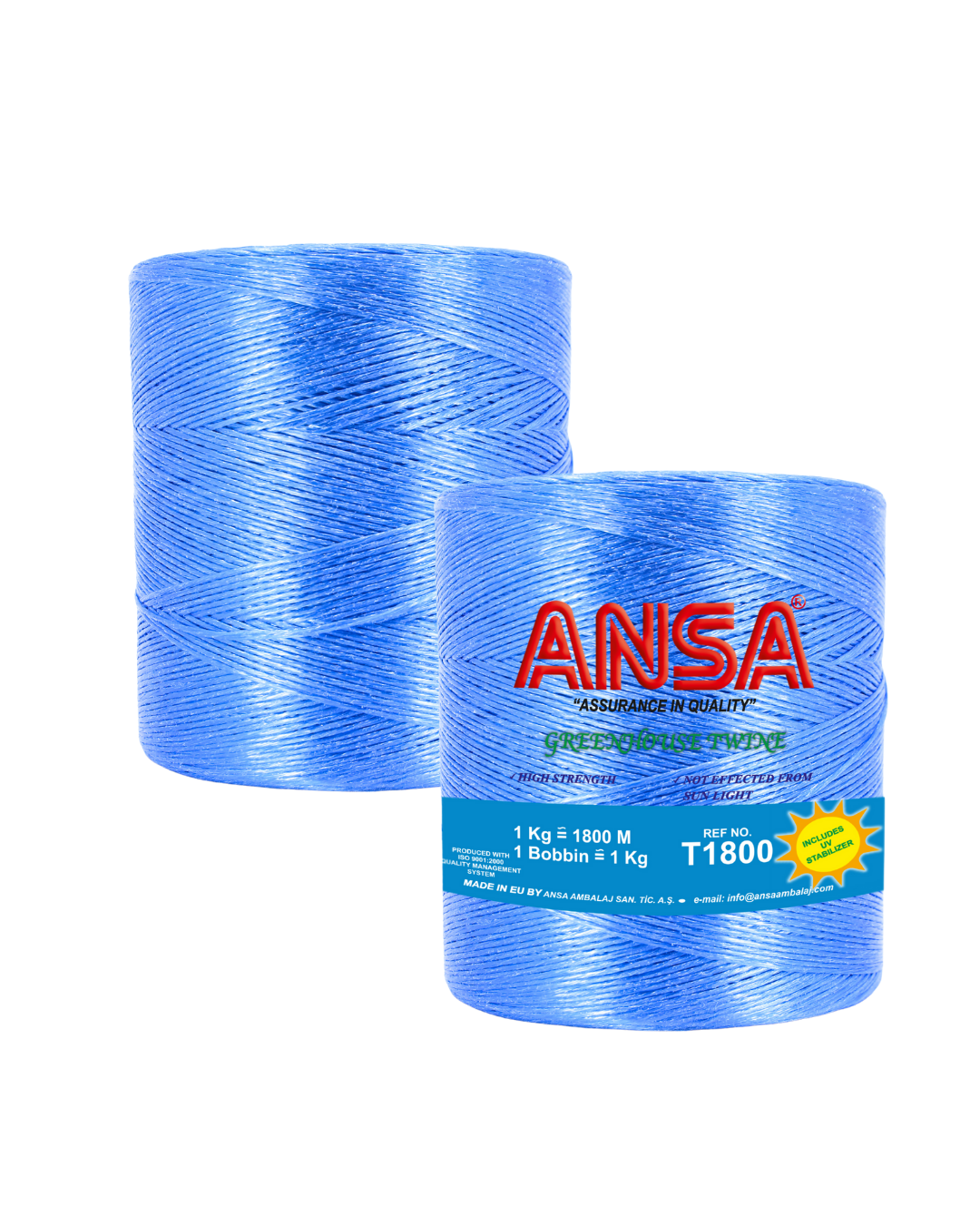
ANSA Greenhouse Twine, verbatim from the product page (metric):
| Property | Value |
|---|---|
| Type | T1800 |
| m/kg | 1800 |
| Breaking Load (kg) | 23 |
| Spool Weight (kg) | 1 |
| Length / Spool (m) | 1800 |
| Spool / Pallet | 900 |
| Kg / Pallet | 900 |
| Color | Blue, Green |
The form of packaging and color may vary according to customer demand.
Three rows do most of the decision work:
- Breaking Load 23 kg against a ~6 kg plant load is a static safety factor of roughly 3.8× (derived from the ANSA table value and the WUR measured plant weight). This is the margin that carries the dynamic spikes and the season-long degradation on top of the static weight.
- m/kg 1800 is the linear density in the grower’s own denomination: 1800 m of twine per kilogram, i.e. about 0.56 g per metre (derived from the published m/kg). Specialist suppliers denominate tomato-hook twines as 1/1000, 1/1200 and 1/1500 (m of twine per kg) and size thickness to the crop’s weight — heavier crops take the lower, thicker numbers (Royal Brinkman). At 1800 m/kg this is a fine, lightweight line at the light end of that scale; it is matched to crops and structures where the per-plant load is moderate and spool economy matters.
- 1 kg spools × 1800 m × 900 spools per pallet (900 kg/pallet) is the logistics arithmetic: one kilogram of twine runs a high-wire row, and a full pallet is 900 one-kilogram spools — clean planning units for a season’s planting schedule.
The type number itself follows the same convention as the m/kg row: T1800 = 1800 m per kg.
Crops and segments
ANSA specifies the product for peppers, cucumbers, tomatoes and eggplants grown in greenhouses, supporting the plant in an upright position with UV protection, high carrying capacity and low elongation (ansa.tr product page). Read as segments, that crop list tracks the load logic above:
- Truss tomato (high-wire) — the reference case: a full-season plant measured at up to 6 kg on the line (WUR), the crop with the longest season and the tallest structure; modern greenhouse cultivars reach roughly 9–12 m of stem over a 10-month season (UF/IFAS).
- Pepper, cucumber and eggplant — per-plant loads differ by crop and pruning system, but the sizing rule is identical: compare the mature plant’s hanging weight to the 23 kg breaking load and keep the same order of margin the WUR data shows for tomato.
- Structure note: the segment definition here is the duty the line sees — gutter height and free fall set how much stem hangs on the twine and how much lies on the gutter, which is why the same crop can load its twine differently in two houses (WUR).
One honest gap: the product page reports linear breaking load only, not knot strength. Knots are the weakest point of any tied line (a knotted textile joint retains only part of the linear breaking load), so tying practice at the hook and the tomato hook’s own geometry deserve as much attention as the twine spec — this is why specialist guidance couples twine choice to hook type (Royal Brinkman). Breaking load per ISO 2062 is the standard single-yarn test method for comparing lines on a like-for-like basis.
UV: the quiet half of the decision
Polypropylene is not naturally UV-resistant; without stabilisation it can lose a large fraction of its strength within a year of outdoor-level exposure (Palmetto Industries). The chemistry that fixes this is well studied: hindered amine light stabilizers (HALS) and related stabilizer systems retard the photo-oxidation that otherwise cracks and embrittles PP under daylight (Brostow et al., 2020). A greenhouse line does not see full sun, but it does see the radiation that gets through the glazing, ten months at a time — which is why the product’s own description leads with UV protection and long service life (ansa.tr).
The colored twines (blue, green) serve an operational purpose as well: color helps crews keep crop blocks and planting cycles apart on the same house, and colored variants can be ordered per box for that reason (Royal Brinkman).
Production and sustainability context
Greenhouse Twine is produced by ANSA Ambalaj (Gaziantep) from polypropylene under the company’s certified management systems: ISO 9001:2015 (production control), ISO 14001:2015 (environmental aspects) and ISO 50001:2018 (energy management). The sustainability case for a durable support line is written over the season: a line that survives the full crop cycle without replacement avoids the waste stream of mid-season re-strings, and polypropylene (resin code 5) is mechanically recyclable at end of life. Low elongation matters for the same reason a straight crop matters — the line does its structural job without creeping.
Decision shortcut
- Full-season greenhouse crops (tomato, pepper, cucumber, eggplant) with moderate per-plant load → ANSA T1800: 23 kg breaking load, 1800 m/kg, 1800 m on a 1 kg spool.
- Check the margin, not just the load: compare your crop’s mature hanging weight (≈6 kg measured for truss tomato at 5 m gutter / 3.75 m free fall) against the 23 kg breaking load and keep the ~3.8× class of margin for spikes and season-long UV aging.
- Color and packaging are planning tools: blue or green, 900 spools per pallet, and packaging/color adaptable to customer demand (ansa.tr).
Before you specify
If you can state your crop, your gutter height and free fall, and your planting schedule, the remaining question is volume and color — request the current specification and a sample before committing the season:
- Product page: ansa.tr/greenhouse-twine
- Contact: ANSA Ambalaj — www.ansa.tr
References
- ANSA. Greenhouse Twine — product page and Technical Specifications. https://ansa.tr/greenhouse-twine/
- Eveleens, B. & Blok, C. Biodegradable twines in horticulture. Report WPR-979, Wageningen University & Research. https://edepot.wur.nl/534525 (truss tomato plant load 6 kg; twine break load ≈18 kg in test).
- Royal Brinkman. How to pick the right twine for tomato hooks. https://royalbrinkman.com/knowledge-center/crop-rotation/twine-tomato-hooks (selection variables: crop, maximum plant load, UV; 1/1000–1/1500 m/kg denominations; colored twine usage).
- Brostow, W. et al. Effects of UV Stabilizers on Polypropylene Outdoors. Materials, 2020. https://pmc.ncbi.nlm.nih.gov/articles/PMC7178429/ (HALS stabilization mechanism).
- Palmetto Industries. Is Polypropylene UV Resistant? https://www.palmetto-industries.com/polypropylene-uv-resistance/ (unstabilized PP strength loss under UV exposure).
- ISO 2062:2009, Textiles — Yarns from packages — Determination of single-end breaking force and elongation at break. https://www.iso.org/standard/94513.html ; test setup overview: Instron, https://www.instron.com/en/testing-solutions/iso-standards/iso-2062/
- Hochmuth, G.J. Production of Greenhouse Tomatoes — Florida Greenhouse Vegetable Production Handbook. UF/IFAS HS788/CV266, 2018. https://ask.ifas.ufl.edu/publication/CV266 (plant length ≈9–12 m over a 10-month season).
- Greenhouse Grower. Your Guide to High-Wire Tomato Growing. https://www.greenhousegrower.com/production/your-guide-to-high-wire-tomato-growing/ (high-wire hook and twine unwinding practice).
- ISO 9001:2015; ISO 14001:2015; ISO 50001:2018 — ANSA certified management systems.
This article was prepared by the ANSA Sustainability Unit as a specifier’s decision guide. For comments, corrections, or a technical data request: oguz.cicek@ansaambalaj.com